Emergency Drain Cleaning — Brockton, MA
Emergency Drain Cleaning in Brockton, MA
24/7 dispatch for active backups anywhere in the city, backed by neighborhood-specific knowledge most citywide drain companies don't bother building.
Call Immediately If
- Sewage is backing into a sink, tub, or toilet
- Water won't stop rising in a fixture
- Multiple drains are failing at the same time
- Wastewater is reaching a living space
This Can Usually Wait
- A single slow-draining sink or tub
- A minor gurgle with no backup
- A clog that only affects one fixture
Brockton's Competitive Drain-Cleaning Landscape — And Where We're Different
Brockton is not one uniform housing stock, and treating it like one is exactly why most emergency drain companies give you a generic, copy-pasted response no matter where in the city you're calling from. We don't work that way. From a first-floor clog in a Campello triple-decker to a multi-unit backup in a downtown Victorian to a straightforward grease clog in a newer Montello home, the actual cause — and the right fix — depends on where you are in the city and what's actually in the ground under your property. This page covers the citywide picture; if you want the neighborhood-specific detail, every section of Brockton we serve has its own dedicated page linked below.
Search for emergency drain cleaning anywhere in Brockton and you'll find the same handful of companies: national franchise call centers, templated multi-location lead-gen networks, and one or two genuinely local operators. What almost none of them do is explain why a specific Brockton neighborhood clogs the way it does — they run the same service list and the same generic "24/7 emergency" copy whether you're calling from a 1920s triple-decker or a home built in the 1990s. We think that's a real gap, because the underlying cause of a Brockton drain emergency is rarely random. It's usually a function of when and how a specific part of the city was built.
Naming specific equipment — cable snakes, hydro jetters, sewer cameras — and being straightforward about pricing and city-versus-homeowner responsibility isn't complicated, but it's surprisingly rare in this market. We'd rather tell you plainly what's wrong, what it costs, and whether it's even our problem to fix (versus a call to Brockton's Department of Public Works) than pad out a page with vague promises and no actual local detail.
At a Glance
The Same Emergency, Different Across Brockton
Campello
Original clay and Orangeburg pipe from before the mid-1970s, deforming and narrowing gradually rather than failing all at once.
Downtown Brockton
Dense triple-deckers where 2-3 units often share a single vertical stack — a backup on one floor can trace back two floors away.
Montello
A wider spread of pipe ages thanks to its mixed residential-industrial legacy; newer PVC resists the structural failures common elsewhere.
Cary Hill & Brockton Heights
Sloped ground means a compromised line shows symptoms faster once genuinely obstructed than on flat terrain.
Crescent Court
A Housing Authority multi-family property where an emergency call functions closer to property-management coordination.
Why the Same Emergency Looks Different Across Brockton
In Campello, one of the city's oldest neighborhoods, we consistently find original clay and Orangeburg sewer pipe installed before the mid-1970s — a bituminous-fiber material that was cheap and fast to install during the postwar building boom but was never designed to last a century. Pipe that old doesn't usually fail all at once; it deforms and narrows gradually, which is why a Campello home that's needed the same drain re-snaked more than once is often telling you something structural, not just experiencing bad luck.
Downtown Brockton presents an entirely different problem despite being just as old. The historic district around City Hall and the Registry of Deeds is dense with triple-deckers and small multi-family buildings where two or three units frequently share a single vertical stack. A backup reported on one floor can originate from a blockage two floors away, and figuring out whether a problem sits in an individual unit's fixtures or the building's shared line changes our entire approach from the moment we arrive — along with the landlord-versus-tenant responsibility question that comes up on nearly every downtown multi-family call.
Montello tells yet another story. Anchored by its own MBTA Commuter Rail stop, the neighborhood's mixed residential-industrial legacy means a wider spread of pipe ages than most single-era sections of the city — but a meaningful share of Montello's housing is newer construction with PVC piping that resists the structural failures common in Campello's older streets. That doesn't mean Montello is clog-proof; it means the emergency calls we take there more often trace back to grease buildup or flushed wipes than to the pipe itself failing from age.
Elevation and terrain matter too, in neighborhoods like Cary Hill and Brockton Heights on the city's east and west sides. On sloped ground, a compromised drain line can show symptoms faster once it's genuinely obstructed than the same problem would on flat terrain — which is part of why we ask about a property's specific location, not just its neighborhood name, when a call comes in from higher ground. And in a multi-family complex like Crescent Court, managed by the Brockton Housing Authority, an emergency call functions closer to property-management work than an individual residential visit, with shared stacks and coordination needs that don't come up in a typical single-family home.
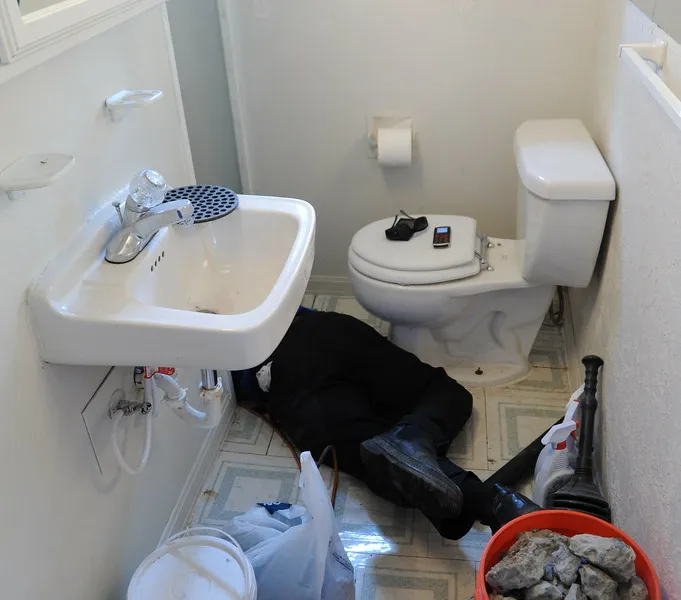
On Site, Fast
We Get to the Actual Access Point — Not Just the Nearest Fixture
A lot of emergency drain problems aren't sitting right at the fixture you first noticed — they're further down the line, and getting to them sometimes means working under a sink, behind a toilet, or through a cleanout that hasn't been touched in years.
We come prepared to find the real access point rather than treating only the symptom fixture, because a backup that keeps returning after a quick fix usually means the technician stopped at the first drain instead of tracing the problem to where it actually starts.
What Counts as an Emergency
Not every clog is an emergency, and we won't treat one like it is just to get a truck out faster. A true emergency is active sewage backing into a fixture, water that won't stop rising, multiple drains failing at once, or wastewater actively entering a living space. A single slow kitchen sink can usually wait for a scheduled visit. If you're not sure which category your situation falls into, describe what's happening when you call and we'll tell you honestly — including if it can wait until morning.
While you're waiting for emergency service to arrive, stop using every drain and fixture connected to the affected line — running more water into a backed-up system usually makes the overflow worse. If sewage has reached a living space, keep people and pets away from the area; wastewater exposure is a genuine health hazard, not just a cleanup inconvenience. If you can safely access the main water shutoff and the issue involves a supply-line problem rather than a drain backup, shutting it off can limit damage. Take photos of the affected area for your own records or an insurance claim, and avoid pouring any chemical drain cleaner into an already-struggling line — on older clay, cast-iron, or Orangeburg pipe, aggressive chemicals can do more harm than good.
Our Citywide Response
When a call comes in from anywhere in Brockton, we ask about the home's age, construction type, and neighborhood before a technician even leaves — because those details meaningfully narrow down the likely cause before we ever turn a wrench. On site, we diagnose before we treat: a snake test clears the immediate blockage, and if the pattern suggests something structural — aging pipe, root intrusion, a shared-line issue in a multi-family building — we'll recommend a camera inspection so you can see exactly what's happening rather than guessing. You get a price before any work starts, and if we run a camera, the footage is yours to keep, whether you're a homeowner, a landlord, or a property manager who needs it for their own records.
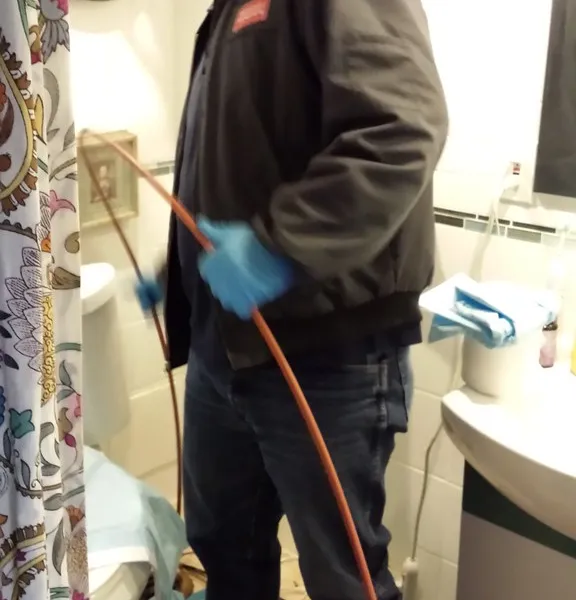
Equipment On Every Truck
Cable Machines Ready to Go, Not Ordered After Diagnosis
An emergency call doesn't leave room for a second trip because the right equipment wasn't on the truck. Every technician carries cable machines sized for both a fast fixture-level clear and a full main-line run, so the diagnosis and the fix can happen in the same visit.
If what we find on site points to something beyond a standard clear — a structural defect, a shared-line issue in a multi-family building — we'll say so and walk you through the camera-inspection option before recommending anything further.
Reducing Your Risk of a Repeat Emergency
Regardless of which Brockton neighborhood you're in, a few habits meaningfully cut down on emergency calls. Keep grease and oil out of kitchen drains entirely — it's the single biggest contributor to buildup in aging pipe, where reduced diameter already leaves less margin for error, and it still clogs even brand-new PVC over time. Make sure everyone in the household knows not to flush wipes (including ones labeled "flushable"), paper towels, or feminine hygiene products. If a drain has needed snaking more than twice in twelve months, ask for a camera inspection rather than a fourth round of the same temporary fix — catching a deteriorating section of pipe before it fails completely is a smaller job than an emergency dig after it collapses.
If you own a property built before the 1970s anywhere in the city and have never had a camera inspection done, it's worth considering even without an active problem. Knowing whether your lateral is clay, Orangeburg, cast iron, or already-replaced PVC changes how you budget for future maintenance and turns every future service call into a known quantity instead of a guessing game.
Emergency Drain Cleaning By Neighborhood
Every neighborhood we serve has its own dedicated page with the specific local knowledge that neighborhood actually needs — not a citywide script with the name swapped in. Find your area below for details on your neighborhood's housing stock, pipe history, and what our response looks like there.
The Real Cost of Waiting on an Emergency
Standing water and active sewage exposure aren't just unpleasant — they carry real, escalating costs the longer they're left unaddressed. Water damage to flooring, drywall, and subflooring typically begins within hours, and the window before mold growth becomes a genuine concern is measured in 24 to 48 hours in a warm, humid basement or crawlspace, not days. Insurance carriers also distinguish between sudden, accidental damage and damage that resulted from a delayed response to a known problem — the longer a homeowner waits after noticing an active backup, the more likely a claim gets scrutinized or partially denied on the grounds that reasonable steps weren't taken to limit the damage. None of this is meant to create panic over a minor slow drain; it's meant to explain honestly why we treat a genuine active backup as time-sensitive rather than something that can comfortably sit on a routine schedule.
How It Works
You Call, We Ask Real Questions
Which fixture, how many drains, how long it's been happening — before a technician even leaves.
We Diagnose Before We Treat
A snake test tells us a lot; we don't jump to the most expensive tool by default.
You Get a Price First
No open-ended time-and-materials guessing. You know the number before work starts.
We Show You What We Found
If we run a camera, you see the footage. No black-box diagnosis.
Common Questions — Emergency Drain Cleaning in Brockton
How much does emergency drain cleaning cost?
Emergency and after-hours service typically carries a premium over standard daytime scheduling — industry-wide, that's commonly a 30-50% surcharge, and hourly rates in this trade generally run somewhere in the $135-190/hr range before any emergency premium. The exact number depends on what's actually wrong, the time of day, and whether the job is a straightforward snake or something that needs hydro jetting or a camera inspection. We give you a firm price before any work starts — not an estimate that changes once a technician is already on site.
Why is my drain backing up, and what causes a clogged main sewer line?
The most common causes across Brockton are grease and fat buildup narrowing a pipe's interior over years, tree roots working their way into a joint or crack and expanding until they choke the line, and material like wipes, paper towels, or feminine hygiene products catching at a fitting and accumulating debris around them. In the city's older neighborhoods, aging clay or Orangeburg pipe adds a structural failure mode on top of those usage-based causes — the pipe itself narrows or deforms under decades of soil pressure. Which cause is most likely at your specific property depends heavily on the home's age and construction era, which is why we ask about both before a technician even leaves for the call.
Is a sewer backup an emergency?
Some are, some aren't, and we won't treat a minor issue like a crisis just to get a truck out faster. A genuine emergency is active sewage backing into a fixture, water that won't stop rising, multiple drains failing at once, or any situation where wastewater is actively entering a living space. A single slow kitchen sink can usually wait for a scheduled visit. Describe what's happening when you call and we'll tell you honestly which category you're in.
How do I know if I have a main line clog or just a single fixture clog?
If only one drain is slow or backed up, the problem is usually isolated to that fixture's own trap or branch line. If multiple fixtures throughout the house are affected at the same time — especially the lowest drain in the house, often a basement floor drain or first-floor toilet — that points to a main line clog affecting the whole property. Main line problems need different equipment and a different diagnostic approach than a single fixture, so telling us which pattern you're seeing helps us bring the right setup the first time.
What's the difference between drain snaking and hydro jetting?
A cable snake pushes through a blockage and clears an immediate path — fast, effective for a single obstruction, and usually the right first move on an emergency call. Hydro jetting uses high-pressure water to scour the entire interior wall of the pipe clean, removing grease buildup, scale, and root mass rather than just punching through the middle of it. If a line keeps clogging in the same place after repeated snaking, jetting is usually the more durable fix. We'll tell you plainly which one your situation actually needs.
Who is responsible for a sewer line — the city or the homeowner?
In Brockton, the city's Department of Public Works maintains the sewer mains running under the street and operates its own emergency response for problems in those city-owned lines. The property owner is responsible for the lateral pipe connecting the home to that main — including the section under the yard and typically the sidewalk. If you're not sure which side of that line a problem sits on, a camera inspection settles it definitively, and we'll tell you honestly if what you're dealing with is actually a call to the city rather than to us.
What are the signs I need a sewer camera inspection instead of a simple snake?
If a drain has needed snaking more than twice in the same spot within a year, that repeat pattern usually means something structural is going on that a snake alone won't fix — a sagging section of pipe, root intrusion at a joint, aging clay or Orangeburg pipe narrowing from the inside, or a partial collapse. Slow drains that never quite clear completely, recurring sewage odor, or any home built before the 1970s that's never had its lateral inspected are all good reasons to ask for a camera inspection rather than waiting for the next emergency to force the question.